Understand the concepts in a fun-filled manner!
For those of you meeting the Davengers for the first time, let me introduce you to this brilliant and fun-loving team.

The Davengers (short for Data + Avengers) are a group of friends with a shared passion for data science, machine learning, problem-solving, and a fair bit of friendly flirting and banter.
Curious to know more about them, check out this guide to 10 Statistical Concepts Every Aspiring Data Scientist Should Know.
Now, back to today’s task: the Davengers have been hired as consultants by Lightworks Company to solve a real-world Linear Programming (LP) problem.
Problem Statement
The Lightworks Company produces:
- Product A: Each unit requires 1 unit of frame parts and 2 units of electrical components.
- Product B: Each unit requires 3 units of frame parts and 2 units of electrical components.
But they have limited resources:
- 200 units of frame parts.
- 300 units of electrical components.
The profit per unit is:
- $2 for each unit of Product A.
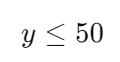
- $4 for each unit of Product B, but they can only profit from up to 50 units of Product B. Any production beyond 50 units doesn’t add any additional profit.
The Challenge:
The Lightworks Company needs to figure out how many units of Product A and Product B to produce to maximize their profits, while making sure they don’t exceed their available resources.
But before we jump into it, let’s take a step back and talk about what Linear Programming (LP) is, and why it’s such a valuable tool for solving real-world business problems.
What is Linear Programming?
Arjun cleared his throat as the group settled into their favorite café. “Before we get into the nitty-gritty of Lightworks’ problem, let’s talk about what exactly we’re doing here.
Linear Programming, or LP, is a mathematical technique used for optimization—basically, it’s a way to maximize or minimize something, like profit or cost, given a set of constraints.”
Aarav, never the one to miss his chance, grinned and looked at Sakshi. “So if I were optimizing my chances of taking you out for dinner, I should use LP to maximize the probability, correct?”
Sakshi, without wasting a second, shot back, “Good luck formulating that model, Aarav. I’m sure there are some pretty tight constraints in there.”
Everyone chuckled, but Vikram, always the voice of reason, refocused the group.
“Let’s stick to business here. LP is about finding the best possible outcome while respecting certain limitations. In this case, we’re trying to figure out how many light fixtures Lightworks should produce to maximize their profit.”
Key Components of Linear Programming
Ananya, the math genius of the group, took over. “So, there are a few important components of any Linear Programming problem that we need to keep in mind.”
She pulled up a notepad and started listing:
- Objective Function: This is what you’re trying to optimize. In Lightworks’ case, it’s profit.
- Decision Variables: These are the variables that impact the objective function—how many units of Product A and Product B to produce, in this case.
- Constraints: These are the limitations or restrictions that you have to work within, like the number of frame parts and electrical components available.
- Non-negativity Constraints: The decision variables can’t be negative—like, you can’t produce negative products!
Aarav, pretending to be deep in thought, mused, “So, no negative dinner dates then?”
Sakshi laughed. “If you keep this up, Aarav, you’ll be optimizing for a no-show.”
Types of Linear Programming
Arjun, who loved a good technical deep dive, added, “You should also know that there are different types of Linear Programming. The one we’re using for Lightworks is called ‘Simplex Linear Programming,’ but there’s also Integer Linear Programming, where the decision variables must be whole numbers.”
Sakshi, trying to keep things moving, jumped in, “But for now, let’s stick to what we’re dealing with—basic LP, where the solution doesn’t have to be a whole number. So yes, Aarav, in theory, you can take 0.5 of me to dinner.”
Steps to Formulate a Linear Programming Problem
Vikram, the strategy guy, chimed in, “Alright, let’s break this down into steps. First, we define our decision variables.”
- Decision Variables:
Let:
- x be the number of units of Product A produced.
- y be the number of units of Product B produced.
Arjun, ever the math enthusiast, added, “Once we’ve got that down, we can focus on maximizing the profit.”
2. Objective Function:
Sakshi, while sipping her coffee, explained the next step. “The goal is to maximize profit. For every unit of Product A, we make $2, and for Product B, we make $4 — up to 50 units. Anything beyond that doesn’t add any profit.”
Profit Function:

Aarav, grinning, leaned towards Sakshi, “I bet if I was in charge of sales, I’d find a way to profit from all 100 units of Product B.”
“Aarav, you’re capped at 50 winks per day, too, so keep it within limits.”, replied Sakshi.
Everyone laughed, and Arjun jumped in to refocus the conversation, “And don’t forget, we need to limit the number of Product B units to 50. Otherwise, we won’t maximize the profit properly.”
3. Constraints:
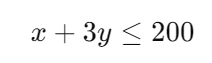
Frame Parts Constraint:
Each unit of Product A requires 1 unit of frame parts, and each unit of Product B requires 3 units of frame parts. The company only has 200 frame parts:
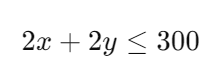
Electrical Components Constraint:
Each unit of Product A requires 2 units of electrical components, and each unit of Product B also requires 2 units of electrical components. The company has 300 electrical components:
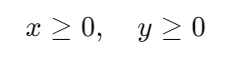
Non-Negativity and Profit Limiting Constraints:
- The number of units produced cannot be negative:
- The number of units of Product B must be capped at 50 units to ensure profit maximization:
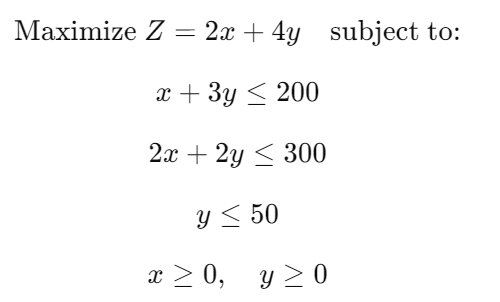
Ananya, summarizing while taking notes, said, “So, the full model formulation looks like this:”
Linear Programming Model:
Wrapping Up the Discussion:
Aarav, spinning his pen, joked, “Alright, alright. I guess it’s not all about charm, huh? I suppose I’ll leave the heavy math to you guys.”
Ananya shot back with a grin, “Good idea, Aarav. Stick to what you’re good at — keeping the team entertained while we do the real work.”
Vikram, ignoring the friendly banter, concluded, “This looks good. Now all we need to do is solve the model and find out the optimal number of units to produce for each product.”
To be continued:
In the next stage, the Davengers solve this LP model and find out how many units of each product Lightworks should produce to maximize their profits. Stay connected for more laughs, and of course, more concepts!
Collection of my other blogs could be found here.
- On LinkedIn.
- Career Counselling and Mentorship: Topmate
- Join my Whatsapp Group where I share resources, links, and updates.
Comments
Post a Comment